

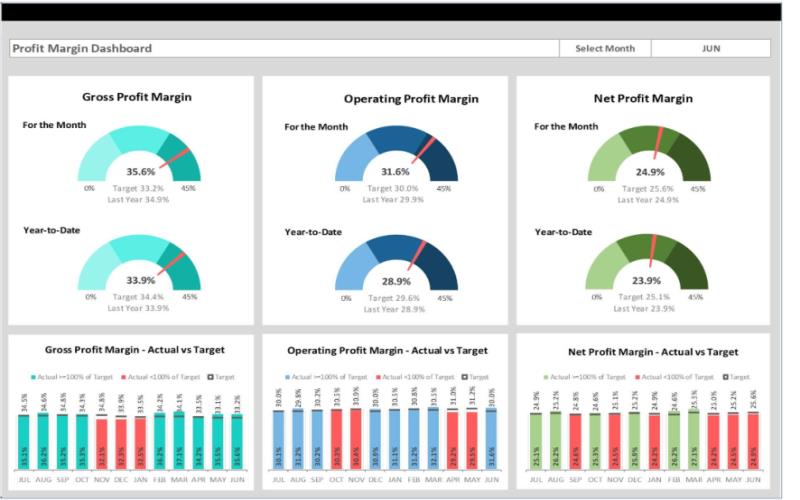
Analyzing profit margins is vital for companies looking to grasp their well-being and operational effectiveness efficiently. A designed profit margin dashboard offers insights into a range of financial measures in real time for decision makers to promptly evaluate and react to shifts, in profitability. This manual outlines the metrics that should be tracked on a dashboard of this kind to aid businesses in enhancing their results.
Key Metrics for Profit Margin
Profit Margin of Operations
The computation and importance of Gross Profit Margin are aspects, in evaluating a company’s profitability from its core operations. This metric is derived by subtracting the Cost of Goods Sold from Revenue and dividing it by Revenue to determine how much a company retains after covering production costs, for its goods and services.
Comparisons with industry standards and goal establishment are crucial for evaluating a company’s profit margin and gauging its competitiveness in the market space. By objectives, with these benchmarks’ enterprises can craft strategies to enhance production efficiency and better manage costs.
Profit Margin of the Net
When we talk about the profit margin it involves considering all costs. Such as operating expenses along with interest and taxes. Alongside any items in relation, to total revenue earned by a company. It gives an insight into how a company’s able to turn its revenue into profit. Keeping an eye on how the net profit margin changes over time and in comparison to industry standards can indicate adjustments, in a company’s strategies and market dynamics that impact planning and operations.
Key Performance Metrics for Operational Efficiency.
Operating Profit Margin
Examining the Effectiveness of Business Operations; The operating profit margin assesses a company’s profitability based on its core activities by dividing earnings before interest and tax (EBIT) by revenue and excludes operational elements such, as taxes and interest, from the calculation. Analyzing the fluctuations and patterns in operating profit margin can provide insights for long term strategic decision making by highlighting impacts on investments in technology and adjustments, to operational processes over time.
Profit before interest taxes depreciation and amortization margin.
EBITDAs significance, in assessing profitability lies in its ability to offer a perspective on the performance of routine business operations by excluding the influence of financial and accounting choices such, as interest payments and tax obligations. Using the profit margin before interest and taxes (EBITDA) is essential for evaluating how well a company is running its operations and managing its finances effectively from both an external perspective.
Insights on Generating Revenue
Keep an eye on how your revenue grows with time by looking at the percentage increase in sales over a period of time which’s essential for evaluating the success of your marketing tactics and changes, in market demand. The connection between increasing revenue and profit margins is vital for businesses to tune their sales tactics. Enhance overall profitability.
Revenue per worker
Assessing Productivity, by Revenue Creation Methodology Evaluation; This gauge assesses the revenue each staff member generates to offer insights into workforce productivity and operational efficiency. Evaluating Revenue per Employee in Relation to Industry Norms; Comparative analysis of revenue generated per employee can assist companies in evaluating their workforce efficiency and productivity relative, to industry peers.
Key Performance Indicators for Controlling Expenses
Keeping track of the cost of goods sold (COGS) relative to revenue is crucial for businesses to grasp the expenses of production compared to sales and ensure they sustain profitable margins effectively. Strategies to Enhance Inventory and Production Cost Efficiency; Examining this measure helps in areas where costs can be reduced in sourcing materials and managing inventory levels.
Exploring the Influence of Operating Costs on Profit Margins. This measurement examines operating expenditures to income to showcase the portion of revenue allocated to administrative and sales expenses. Managing expenses efficiently to boost profits; It’s important to review and manage operating costs to increase profitability, in industries, with competition and limited pricing flexibility.
Sophisticated Analytical Measurements
The margin of profit contributed by each unit sold.
The significance of Contribution Margin, in evaluating Product Profitability, lies in its ability to ascertain the profit generated by each product after deducting costs, from sales revenue before factoring in fixed costs. Utilizing contribution margin for pricing and cost management is crucial in determining pricing strategies and evaluating how variable costs affect profitability.
Revenue from Sales Percentage (ROS)
Assess the Companys Effectiveness, in Turning Sales into Profits; ROS evaluates how effectively a company transforms sales into profits and offers a view of efficiency. Comparing ROS to industry standards provides insights into a companys efficiency compared to its competitors.
Tricks for Making the Most of Your Dashboard Interface
Customizing the dashboard visuals to cater to the requirements of stakeholders can improve the usefulness of metrics by presenting data in practical formats that are easy to comprehend and take action on. “Utilizing data presentation and layout techniques is key to making information easily understandable and useful, for decision making.”
Tips for Making Informed Decisions Based on Valuable Information
Utilizing Dashboard Information, for Strategic Choices; The information obtained from the dashboard should guide business decisions by assisting companies in adjusting to market shifts and enhancing their outcomes. Implement proactive management strategies by acting based on insights, from the dashboard to address issues before they become problems and maintain a consistent enhancement, in financial well-being.
In summary
Keeping track of profitability measures using a crafted dashboard is crucial for any business that aims to grow and operate efficiently. By reviewing these signs of performance organizations can make choices that improve profitability and operational efficiency. As market conditions change it’s important to update the metrics displayed on the dashboard to ensure they stay in line with the company’s objectives and current market trends. Bizinfograph offers ready-to-use dashboard templates on Finance, Sales, HR and Manufacturing.

